
Home / Projects / CFD Analysis of Flow Characteristics Around an Ahmed Body with Varying Slant Angles Using Ansys
CFD Analysis of Flow Characteristics Around an Ahmed Body with Varying Slant Angles Using Ansys
Project Summary
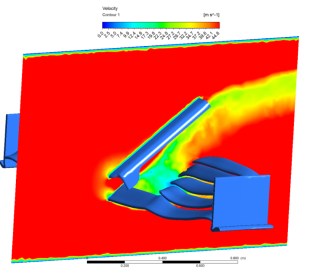
This project focused on conducting a computational fluid dynamics (CFD) study to examine the aerodynamic behavior around an Ahmed body model with different rear slant angles. The Ahmed body, widely used as a benchmark in vehicle aerodynamics research, provides valuable insight into flow separation, drag characteristics, and wake formation patterns. This study aimed to analyze how variations in the slant angle influence flow behavior, pressure distribution, and aerodynamic drag, using Ansys Fluent as the primary simulation tool.
The analysis involved simulating external incompressible flow over the Ahmed body for several slant angles ranging from low to high values. Each configuration was studied under identical inlet conditions to isolate the influence of slant geometry. The numerical simulations included turbulence modeling to accurately predict recirculation zones and wake behavior behind the body. Key performance indicators such as drag coefficient, vortex formation, and surface pressure were extracted for comparison and evaluation.
This type of analysis is critical in automotive aerodynamic design, as optimizing the rear-end geometry of a vehicle can significantly reduce pressure drag and improve fuel efficiency. The project's findings provided a comprehensive understanding of how rear geometry modifications can impact the overall aerodynamic performance of bluff bodies, particularly under turbulent flow regimes.
Objectives and Approach
The main objectives of this CFD study were:
- To analyze the flow field characteristics over an Ahmed body for different slant angles.
- To evaluate how changes in the slant angle affect drag coefficient and wake behavior.
- To identify the critical slant angle at which significant flow separation occurs.
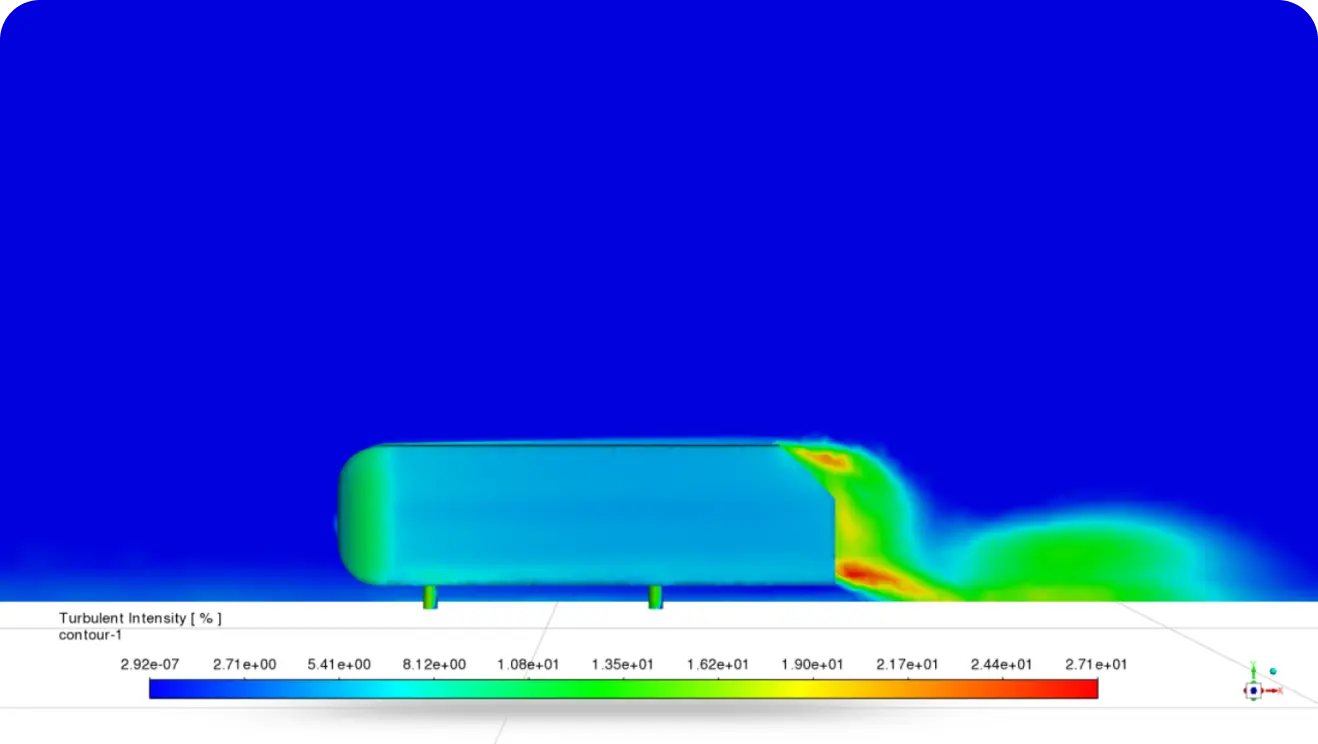
- To investigate turbulence intensity and recirculation patterns in the wake region.
The simulation approach included:
- Building a clean 3D geometry of the Ahmed body with parametric control over the slant angle.
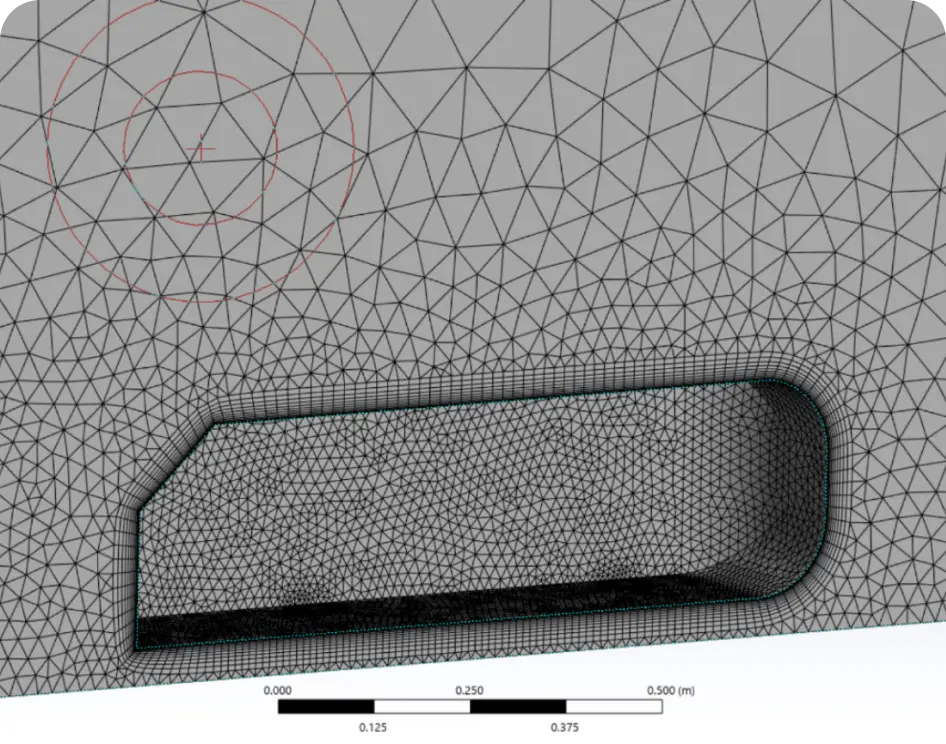
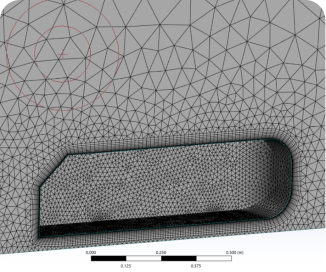
- Creating a structured mesh with refined regions near the wall boundaries and wake zone.
- Defining steady-state incompressible flow conditions with a uniform velocity inlet and pressure outlet.
- Using the realizable k-epsilon turbulence model with enhanced wall treatment to resolve near-wall flow features accurately.
- Running simulations in Ansys Fluent for multiple slant angles, typically ranging from 25° to 40°, and comparing results across each configuration.
Simulation Conditions and Assumptions
- The fluid was considered as air at standard atmospheric pressure and temperature.
- The flow was modeled as steady-state, turbulent, and incompressible.
- No-slip boundary conditions were applied to all body surfaces.
- The Reynolds number was maintained in the range of 1–2 million, representative of scaled vehicle conditions.
- Slant angles evaluated included 25°, 30°, 35°, and 40°, covering the transition region from attached to separated flow.
- The domain size and boundary conditions were set according to best practices to minimize blockage and recirculation effects from domain walls.
Results and Findings
The CFD analysis provided detailed insights into how aerodynamic behavior evolves with changing slant angles. Key findings include:
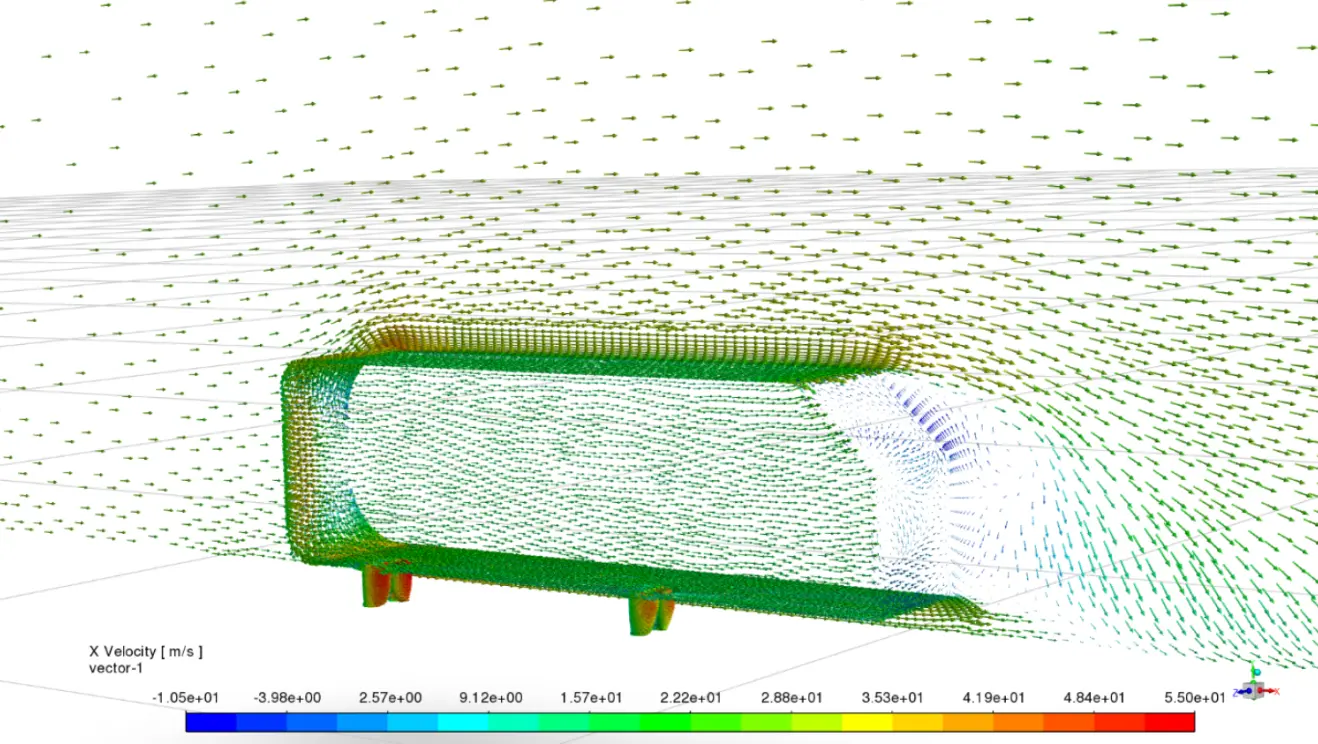
- At lower slant angles (25° and 30°), the flow remained mostly attached to the slanted rear surface, resulting in relatively lower drag and more stable wake.
- At a slant angle of 35°, partial separation occurred, increasing the wake width and causing a noticeable rise in pressure drag.
- At 40°, complete flow separation took place along the slant surface, forming a large recirculation bubble in the wake and significantly increasing the drag coefficient.
- The drag coefficient was observed to increase non-linearly with slant angle, highlighting a critical angle where flow separation begins to dominate the aerodynamic response.
These findings demonstrated how rear-end design can dramatically affect aerodynamic performance, validating the Ahmed body as a valuable tool in conceptual vehicle design optimization.
Our Projects
See how Solvo Products has helped its clients achieve their vision of digital innovation.
Our Technologies
 Contact Us
Get in touch with us