
Home / Projects / FEA Analysis and Optimization of an Industrial Fixture Using SolidWorks Simulation
FEA Analysis and Optimization of an Industrial Fixture Using SolidWorks Simulation
Project Summary
This project involved a comprehensive Finite Element Analysis (FEA) of a custom-designed industrial fixture assembly to evaluate its structural performance under static loading conditions. The primary goal was to assess the fixture's mechanical strength, displacement, strain behavior, and safety factor, and to identify opportunities for geometry-based optimization to ensure high stiffness, minimal deformation, and structural integrity under operational loads.
The simulation was performed using SolidWorks Simulation, employing bonded contact conditions and global meshing across a multi-part assembly. The results provided critical insights into stress concentrations, displacement profiles, and design margins—crucial for ensuring reliability and durability in a production environment.
Objectives and Approach
Key objectives of this study included:
- Performing static structural analysis on a complex fixture assembly using FEA tools.
- Verifying the structural capacity under real-world load conditions (7,664.79 N applied in the Y-direction).
- Identifying maximum stress zones and displacements to evaluate potential points of failure.
- Assessing the Factor of Safety (FOS) across all components to validate the design.
- Supporting fixture weight/stiffness optimization based on simulation insights.
Simulation Results
Stress Distribution (von Mises Stress)
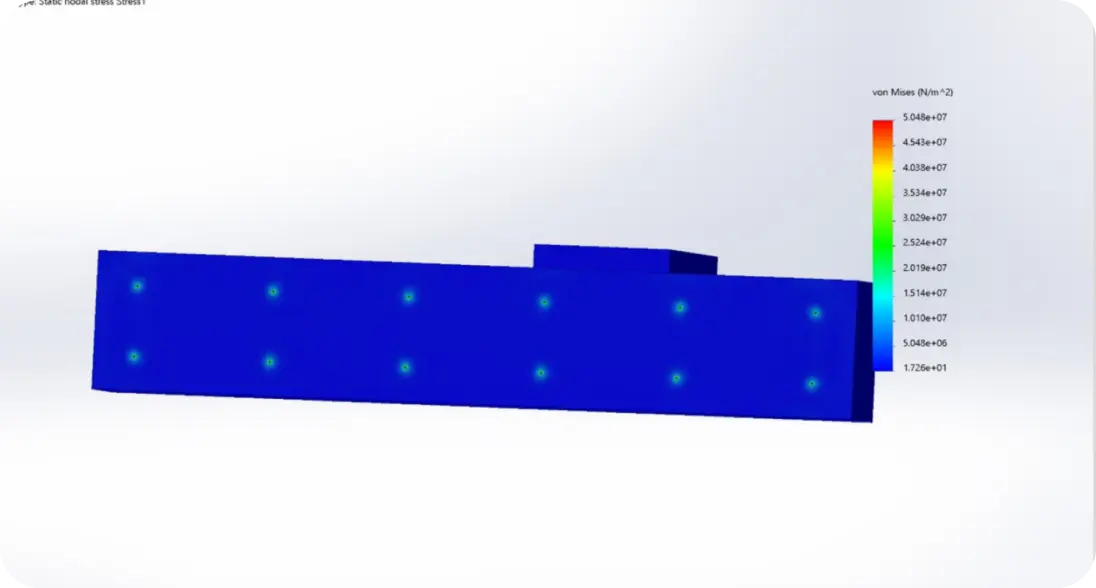
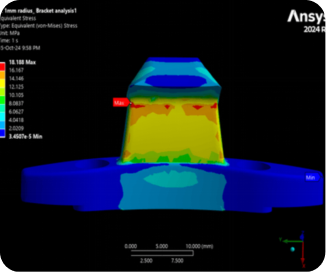
The simulation revealed a maximum stress of 146.8 MPa at Node 13,616 and a minimum stress of 2.25 kPa. The highest stress concentrations were observed around localized connection points and mounting interfaces. However, all stress values remained well within the yield strength of the structural steel used (typically above 250 MPa), confirming the component's structural reliability under applied loads.
Displacement
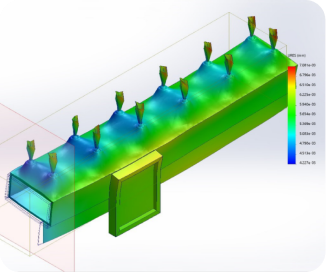
The analysis showed a maximum displacement of 0.00708 mm at Node 18,700 and a minimum displacement of 0.00423 mm. The displacement contour confirmed minimal deflection, demonstrating sufficient stiffness in the fixture, making it ideal for holding or supporting applications where rigidity is crucial.
Strain
The maximum equivalent strain recorded was 4.072e-4, with strain distribution remaining uniform throughout the structure. All values stayed within the elastic region, validating both the material selection and the structural design integrity of the fixture.
Factor of Safety (FOS)
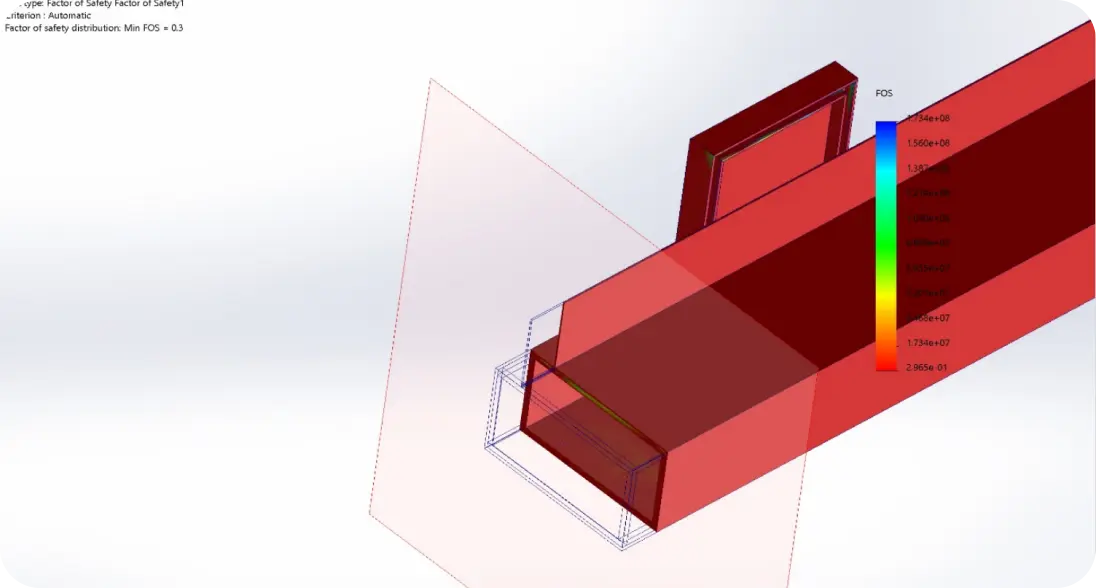
The minimum factor of safety was 4.43 at the location of maximum stress, while the maximum FOS reached 100 in low-stress regions. A minimum safety factor above 4 indicates a highly conservative and robust design, suitable for production environments and high-load handling applications.
Conclusion and Optimization Insight
The FEA results confirmed that the industrial fixture design is structurally sound, exhibiting low deformation, acceptable stress levels, and a high safety margin. The minimal displacement observed under an applied force of nearly 7.7 kN demonstrates that the fixture is well-suited for both heavy-duty and precision manufacturing applications. Given the very high safety factor, there is significant potential for geometry optimization to further enhance performance and efficiency. Possible improvements include reducing material volume in low-stress regions to decrease overall weight, modifying fillet radii or hole placements to eliminate localized stress concentrations, and streamlining the fixture geometry to improve manufacturability and cost efficiency without compromising structural integrity. Overall, this analysis highlights an effective design-to-validation workflow in which CAE tools such as FEA are utilized early in the development phase to ensure optimal performance, structural reliability, and reduced prototyping costs.
Our Projects
See how Solvo Products has helped its clients achieve their vision of digital innovation.
Our Technologies
 Contact Us
Get in touch with us