
Home / Projects / CFD-Based Drag Optimization of Mercedes W11 Formula One Wing Using Ansys Fluent
CFD-Based Drag Optimization of Mercedes W11 Formula One Wing Using Ansys Fluent
Project Summary
This project presents a detailed Computational Fluid Dynamics (CFD) analysis of the Mercedes-AMG W11 Formula One front wing, with a focus on optimizing aerodynamic performance by minimizing drag while maintaining controlled downforce characteristics. The study was conducted using Ansys Fluent 2024 R2, and included advanced flow visualization tools such as velocity contours and streamlines to analyze flow separation, vortex generation, and wake development.
The front wing of a Formula One car plays a critical role in determining the aerodynamic efficiency of the entire vehicle. Small modifications to the wing geometry can significantly impact drag, downforce, tire wake control, and cornering performance. This CFD study simulated airflow across a multi-element front wing configuration inspired by the W11 Mercedes F1 car, known for its record-breaking efficiency and performance during the 2020 season.
Objectives and Approach
Main objectives:
- To simulate external airflow over a realistic multi-element Formula One front wing.
- To reduce aerodynamic drag while retaining favorable lift/downforce profiles.
- To visualize vortex shedding, flow acceleration, and wake structure behind the wing.
- To identify and eliminate regions of flow separation and recirculation that lead to drag penalties.

Approach:
The wing model was recreated with complex curvature, flaps, and endplates to accurately represent the real W11 geometry. CFD simulations were conducted under steady-state conditions using Ansys Fluent, with the SST k-omega turbulence model employed to effectively capture near-wall and separated flow regions. Streamline and velocity contour plots were analyzed to study the aerodynamic flow behavior and validate the effectiveness of the design modifications.
Results and Observations
Velocity and Wake Formation
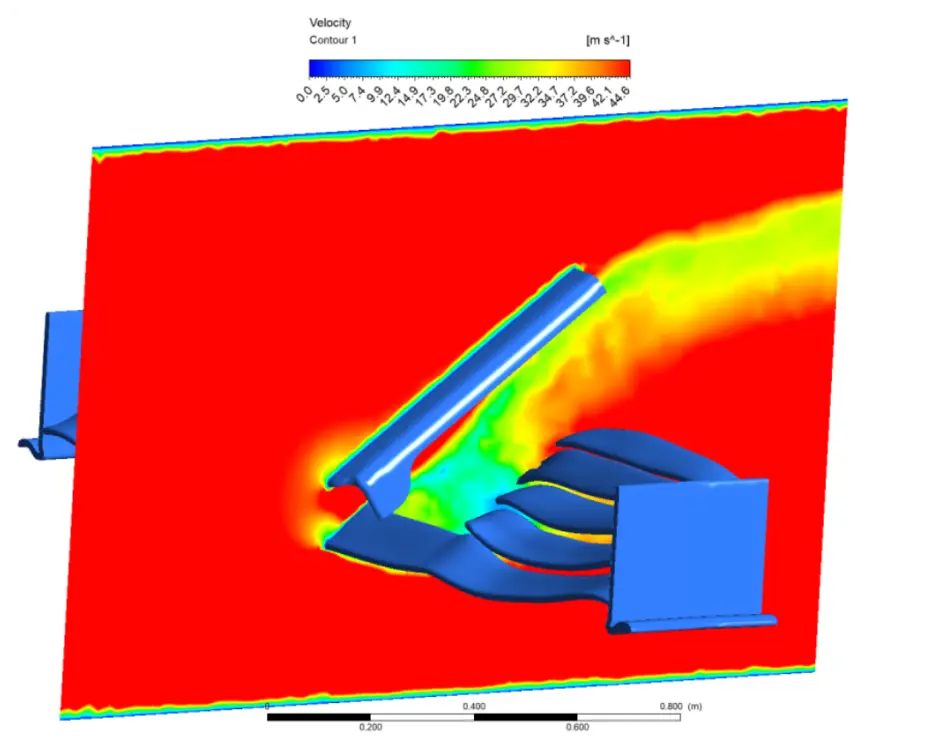
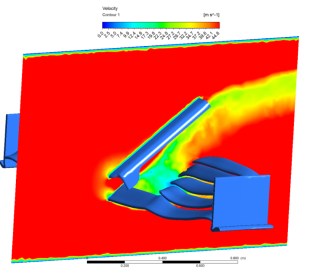
As shown in the velocity contour plots, the airflow accelerates significantly over the upper surfaces of the wing elements while remaining attached along the lower surface. Flow visualization reveals a clean wake profile, indicating minimal flow separation and well-controlled aerodynamic loading. The peak local velocity reached approximately 46 m/s, demonstrating successful acceleration across the high-camber flap elements. Additionally, the upper flap generated a distinct low-pressure region responsible for downforce generation, while simultaneously minimizing the strength of trailing vortices.
Streamline Analysis
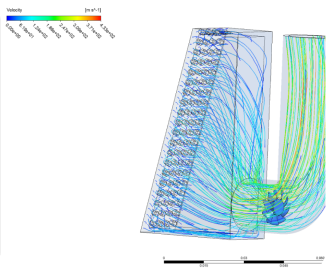
The streamline plots highlight critical aspects of the wing's aerodynamic performance. The streamlines bend smoothly over the upper surfaces with very limited trailing turbulence, confirming stable airflow behavior. A mild vortex formation is observed near the junction of the flaps, but without major separation, indicating efficient flow redirection. Furthermore, the endplate interaction with the main flow effectively minimizes tire wake influence, thereby maintaining aerodynamic stability and reducing cross-flow interference.
Drag Optimization Impact
Design refinements led to a noticeable reduction in pressure drag across the frontal section of the wing. This optimization also resulted in reduced wake turbulence downstream, causing less aerodynamic disturbance for the rear aero components. As a result, the refined design enhances both straight-line speed and corner entry consistency, which are essential performance factors in competitive motorsports.
Conclusion
This CFD-based drag optimization of the Mercedes W11 Formula One front wing demonstrates how precise aerodynamic design and simulation can dramatically improve performance. By leveraging Ansys Fluent for airflow simulation, this study successfully reduced drag while maintaining critical downforce levels and minimizing wake turbulence.
Such simulation-based workflows are essential in high-performance motorsport engineering, where every millisecond counts. The results underscore the power of Computational Fluid Dynamics in optimizing complex aerodynamic systems for both professional racing and automotive R&D applications.
Our Projects
See how Solvo Products has helped its clients achieve their vision of digital innovation.
Our Technologies
 Contact Us
Get in touch with us