
Home / Projects / CFD Analysis of Duct to Optimise Cooling using Ansys
CFD Analysis of Duct to Optimise Cooling using Ansys
Project Summary
This project focused on performing a detailed Computational Fluid Dynamics (CFD) analysis of a custom duct geometry to evaluate and optimize its cooling performance. The analysis was conducted using Ansys Fluent 2024 R2, simulating airflow behavior through a curved duct with internal components designed to enhance heat transfer and airflow distribution.
The main objective was to identify high-velocity zones, pressure drop regions, and flow separation areas to propose design improvements that would lead to more uniform cooling, reduced recirculation, and better aerodynamic efficiency. This type of CFD study is crucial in applications such as HVAC systems, electronics cooling, battery thermal management, and industrial ventilation systems where optimized duct flow directly impacts system performance and reliability.
Objectives and Approach
The key goals of this CFD project were:
- To simulate internal flow behavior through a complex duct geometry.
- To analyze velocity streamlines, static pressure, and flow recirculation zones.
- To identify areas of flow separation and pressure losses that impact cooling efficiency.
- To support design modifications that enhance cooling uniformity and airflow stability.
The study used a steady-state, incompressible flow model with a turbulence solver (SST k-omega) to resolve near-wall effects. The model included features such as turning vanes, flow splitters, and an impeller-like component that significantly affected flow direction and speed. The domain was meshed using a fine resolution grid to capture detailed flow features, especially in curved and confined regions.
Results and Observations
Velocity Streamlines
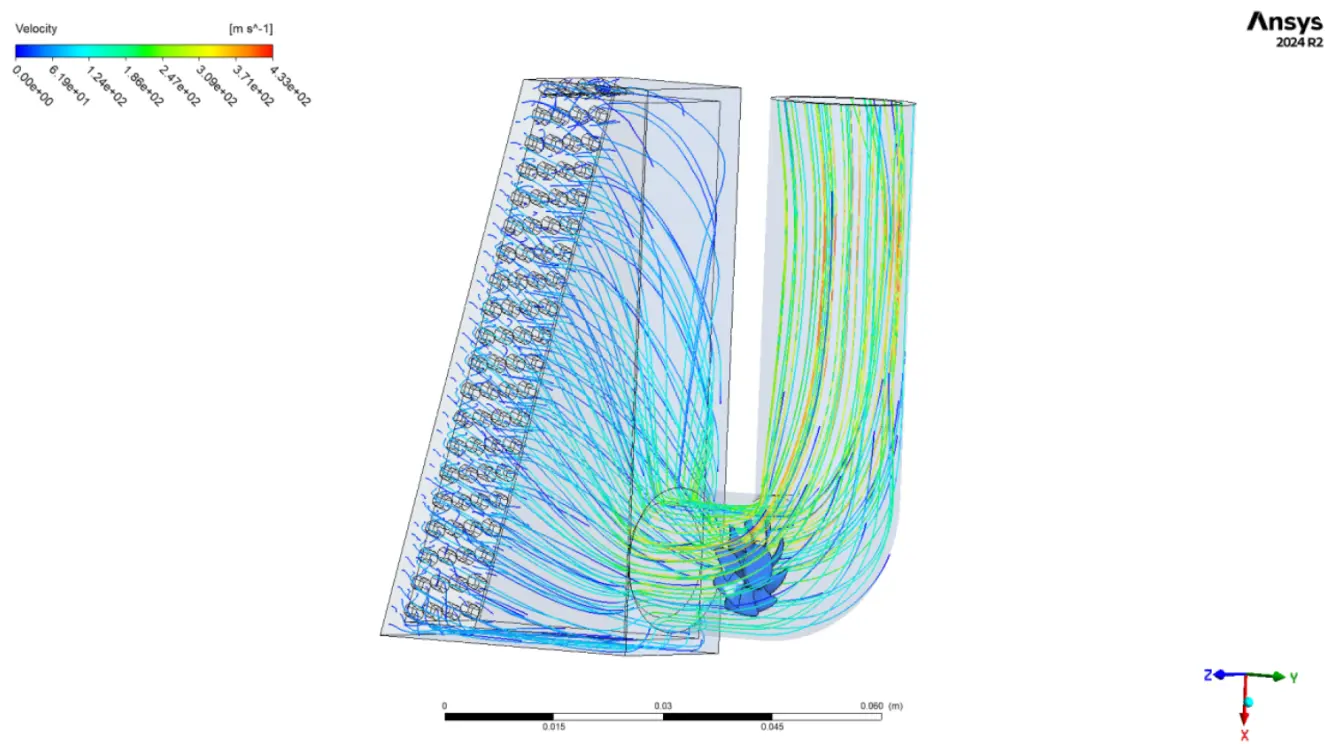
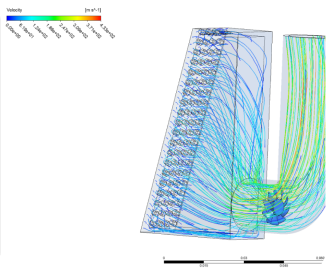
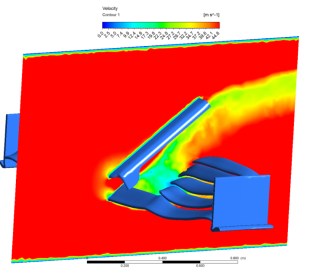
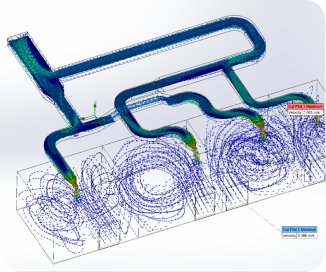
As shown in the velocity plot, the airflow undergoes significant curvature through the duct, with velocities increasing near the impeller region. The flow accelerates around the bend and aligns vertically in the outlet section. Streamlines indicate effective flow guidance after the fan blades, with minimal swirl at the outlet, suggesting well-balanced flow redirection. Maximum flow velocity reached approximately 433 m/s, with localized acceleration observed at narrow cross-sections and vane exits.
Pressure Contours
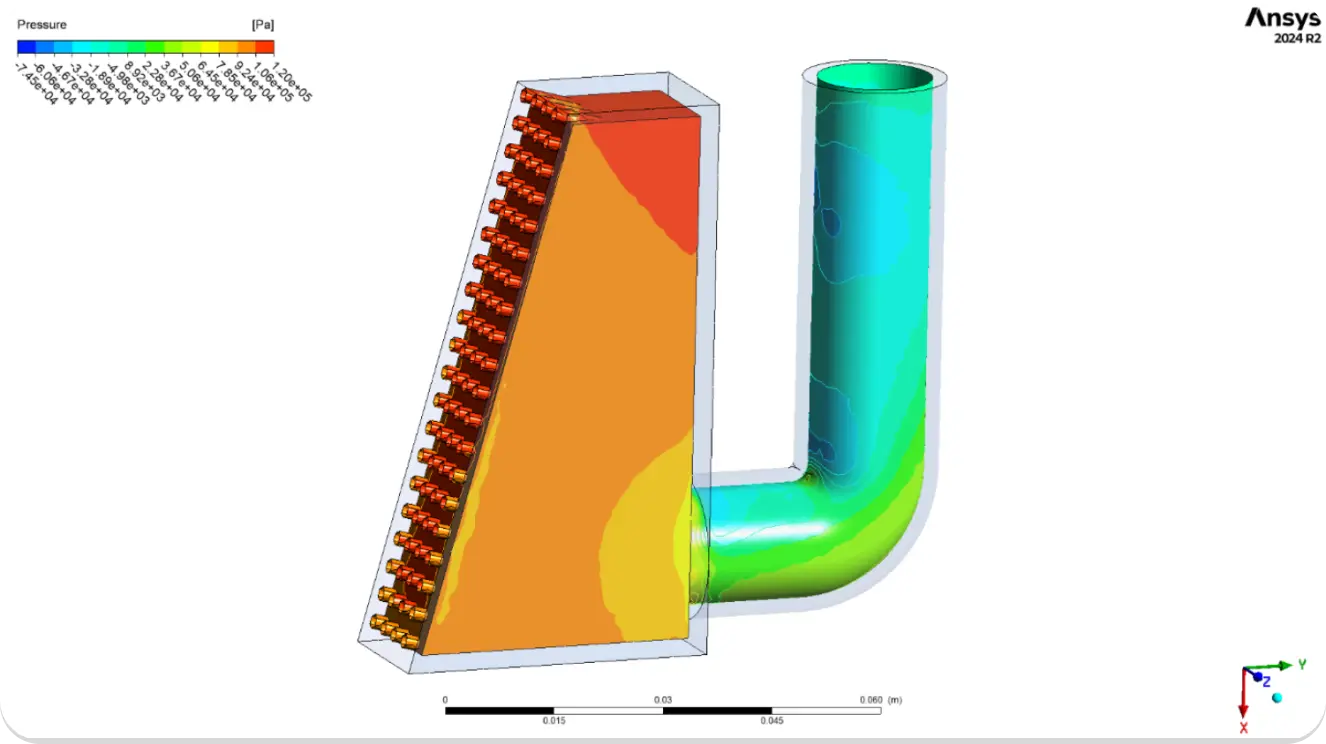
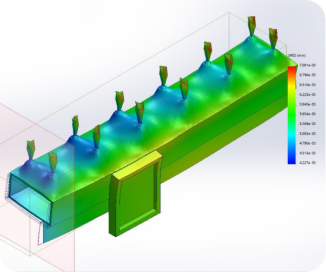
The pressure distribution plot reveals a high-pressure zone at the duct's inlet and near the rotor base, gradually decreasing along the duct's length. The pressure drop is evident across the impeller region, where the conversion of pressure energy to kinetic energy drives flow acceleration. The highest static pressure recorded was around 1.2 × 10⁵ Pa, with notable pressure gradients occurring at the transition between the horizontal and vertical duct segments.
Our Projects
See how Solvo Products has helped its clients achieve their vision of digital innovation.
Our Technologies
 Contact Us
Get in touch with us