
Home / Projects / FEA Analysis of a Beam Bracket for Structural Integrity Using Ansys 2024 R2
FEA Analysis of a Beam Bracket for Structural Integrity Using Ansys 2024 R2
Project Summary
This project involved conducting a detailed Finite Element Analysis (FEA) on a beam bracket to assess its structural integrity, deformation behavior, and load-carrying capacity under realistic boundary conditions. The simulation was performed using Ansys 2024 R2, focusing on quantifying total deformation, visualizing stress distribution, and evaluating potential areas of mechanical weakness in the bracket's geometry.
Beam brackets are critical mechanical components widely used in structural frames, machinery bases, and mechanical linkages. Ensuring that such brackets maintain stiffness and strength under load is essential for product safety and performance. This analysis provided actionable insights for design validation and geometry optimization.
Objectives and Approach
Primary goals:
- To evaluate total deformation under applied static loading.
- To ensure the bracket does not experience excessive displacement or structural failure.
- To identify zones of maximum strain concentration for redesign considerations.
- To verify the bracket meets industrial safety margins under the defined loads.
Simulation setup:
- Software: Ansys 2024 R2
- Solver type: Static Structural
- Mesh type: Tetrahedral elements with refined mesh around critical features
- Loading conditions: Vertical downward force applied on top face
- Constraints: Fully fixed support at base mounting holes
- Material model: Linear isotropic (mild steel, E = 210 GPa)
Key Results
Total Deformation
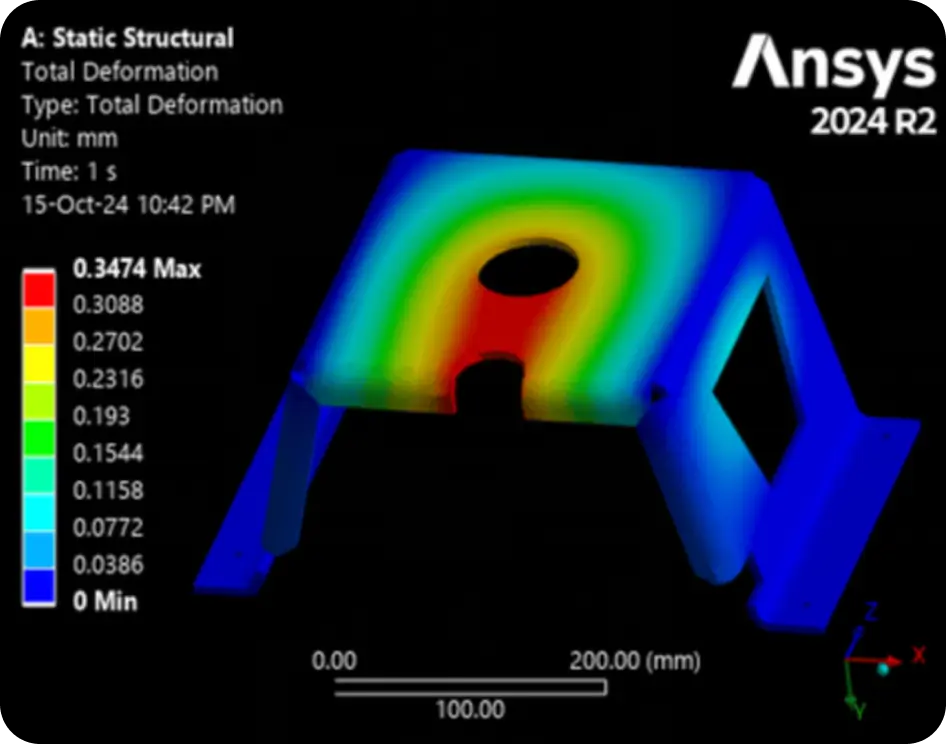
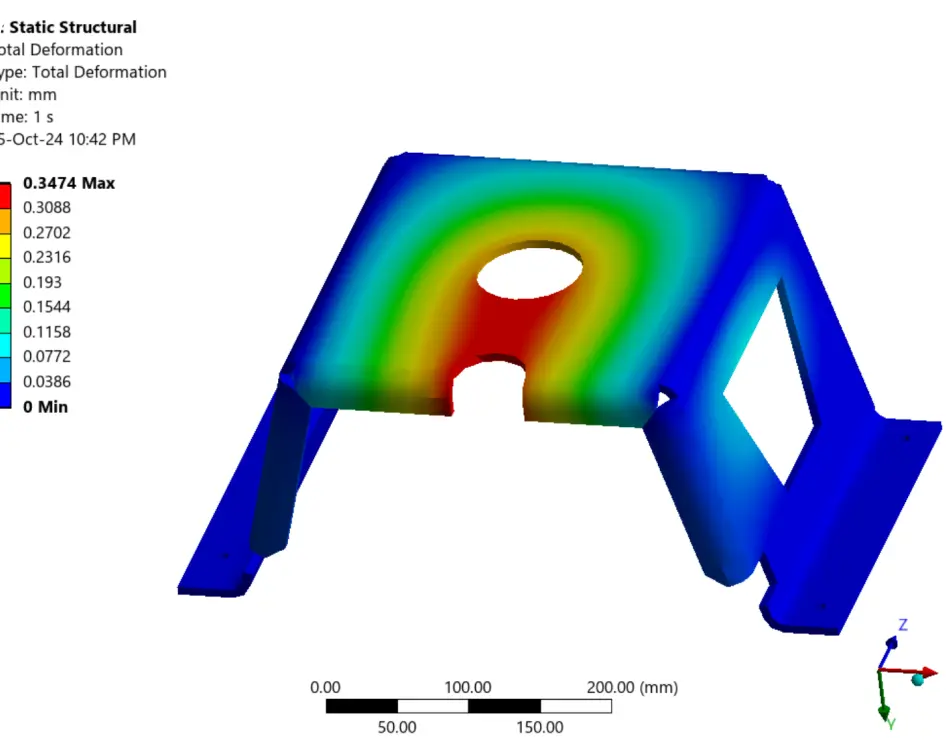
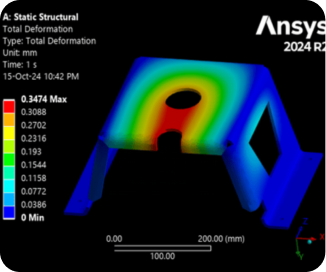
The analysis indicated a maximum deformation of 0.3474 mm and a minimum deformation of 0.000 mm at the fixed boundary. The deformation was primarily concentrated around the top central opening and adjacent fillet regions, which are subjected to higher bending moments and redirection of stress flow. This magnitude of displacement falls well within acceptable engineering limits for static loading applications, thereby confirming the bracket's structural and functional stability under the applied load conditions.
Stress and Displacement Trends
The results demonstrated a smooth and continuous stress gradient, with no signs of stress singularities or severe concentration points. The component exhibited minimal twisting or out-of-plane warping, which validates a symmetrical load distribution and strong geometric stiffness throughout the structure. Furthermore, the stress and strain data (not shown here) remained within the yield limits of mild steel, ensuring safe and reliable performance under the specified design loads.
Conclusion
This FEA-based structural analysis of a beam bracket validates that the design can withstand typical static loading without undergoing excessive deformation. With a maximum displacement of 0.347 mm, the bracket demonstrates excellent stiffness and load resistance. These findings confirm the bracket's suitability for use in structural and mechanical systems where dimensional stability is critical.
The simulation also provides a foundation for further optimization, including potential weight reduction or material substitution, especially in mass-produced or lightweight engineering applications.
Our Projects
See how Solvo Products has helped its clients achieve their vision of digital innovation.
Our Technologies
 Contact Us
Get in touch with us